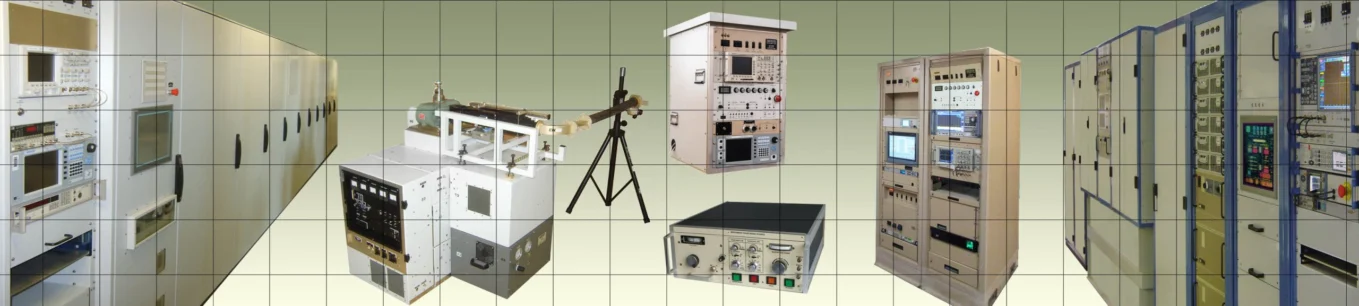
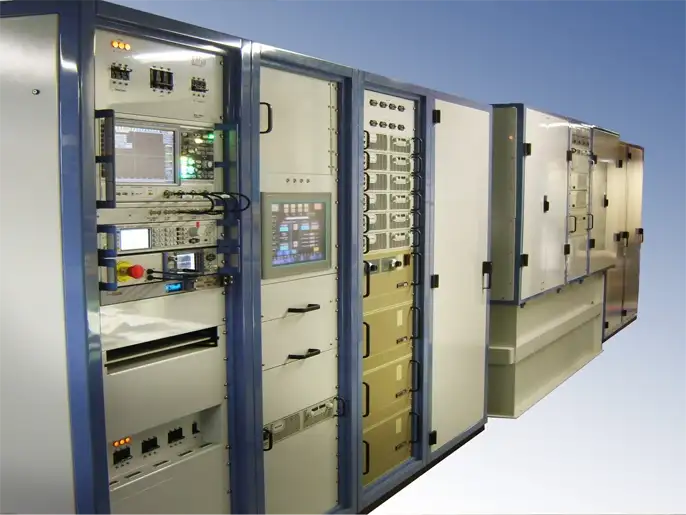
H6 Systems designs and builds custom klystron transmitters and complete klystron-based transmitter systems using pulsed klystrons. Klystrons are vacuum tubes which amplify RF. They have gains typically in the 30-60 dB range. Frequencies range from .5 – 95 GHz with special devices operating even beyond these frequency and gain ranges. Because they are amplifiers, they must be driven by a low power frequency source and differ fundamentally from magnetron transmitters, which are tube oscillators often chosen when lowest cost per watt is the primary consideration.
Klystrons require a specific filament voltage, as well as a solenoid voltage to focus the electron beam. They are usually liquid cooled. Pulse widths range from 4 uS to 1 mS. Duties range from .001 to .03. H6 Systems’ understanding of klystron tubes allows us to build klystron-based transmitters that fit our customer’s needs. Feel free to use our RF System Builder to get your design started.
Klystron-Based Transmitter Applications
Klystron transmitters are used in alternative energy research, radiation oncology, linear accelerators (LINACS), counter-UAV measures, RADAR transmitters, gas ionization experiments, customs and security inspection systems, RF research, and many other areas.
Typical Klystron Specifications
| Unit | K1 | K2 | K3 | K4 | |
|---|---|---|---|---|---|
| Klystron Number | VKL-8271B | VKS-8262G | VKS-8345B | VKC-8313 | |
| Frequency Band | L | S | S | C | |
| Waveguide Size | WR650 | WR284 | WR284 | WR187 | |
| Frequency Range | GHz | 1.25 – 1.35 | 2.9985 | 2.9 – 3.1 | 5.4 – 5.9 |
| Output Power Pk | MW | 2.5 | 7.5 | 4.5 | 3 |
| Duty Cycle | 0.0016 | 0.0010 | 0.0020 | 0.0020 | Pulse Width Max | uS | 9 | 7 | 12 | 12 |
Use the H6 Tube Finder tool to find many other klystrons with a broad range of specifications. Our Field Strength Calculator will help you determine the right klystron tube to generate a particular field strength.
Specialized Design and Integration for Klystron Transmitter Systems
Klystron transmitter design, implementation, and interfacing involves decisions on waveguide pressurization gas, gas dryness and type, reflected rf monitoring, forward and reverse power monitoring, reflected RF protection, maximum average power limit, peak power limit, attenuation, thermal stability vs. RF stability, waveguide flange type, pressure gasket type, and operator interface. H6 Systems can specify, procure, and deliver many of your peripheral components for a complete turnkey system. This can include:
- Waveguide (flange and gasket selection, waveguide material)
- Coax (1-5/8, 3-1/8, larger)
- Coupler (type: crossguide, broadwall, loop, directivity, coupling factor)
- Isolator (load type, load capacity)
- Attenuator (mechanical, automated)
- Reflected RF monitoring (high speed protection)
- Waveguide arc detection (optical)
- Compressor/dryer (compact)
- RF load (air cooled, water cooled jacket, water RF load)
- Waveguide switches (mechanical, coaxial)
- Operator interface (mechanical panel, GUI, touchscreen, dsub, ethernet)
- Cooling (liquid, water/glycol mix)
- Fault monitoring (pulse width, duty, PRF, peak current, thermal, power source, reflected RF)
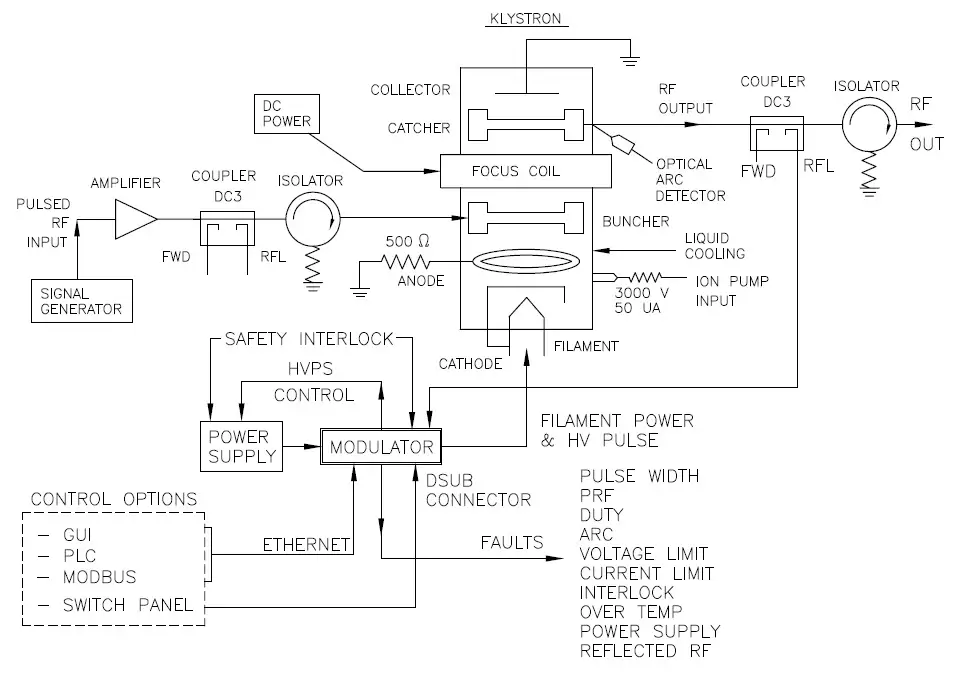
Block Diagram of a Klystron Transmitter
Klystron Transmitter FAQs
What is a klystron transmitter?
A klystron transmitter is a high-power RF system that uses a klystron vacuum tube to amplify a low-power RF input signal into high-power microwave output. Klystron transmitters are commonly used in applications that require stable, controlled RF amplification at high power levels.
Why choose a klystron transmitter instead of a magnetron transmitter?
Unlike a magnetron transmitter, which generates RF directly as an oscillator, a klystron transmitter amplifies an external RF source, making it a better fit for applications where signal control and stability matter.
What information is needed to specify a klystron transmitter?
To specify a klystron transmitter, it is helpful to know the required operating frequency, peak power, average power, pulse width, duty cycle, waveguide size, cooling method, RF drive requirements, control interface, and protection requirements. The output path may also require decisions about couplers, isolators, attenuators, reflected RF monitoring, arc detection, loads, waveguide pressurization, and operator controls. If every detail is not known yet, H6 Systems can help review the application and recommend a partial or complete klystron transmitter configuration.
What frequencies can a klystron transmitter operate at?
Klystrons themselves operate in narrow frequency ranges, however they are available across a wide spectrum, typically from about 0.5 GHz to 95 GHz, with some specialized klystrons operating beyond that range. H6 Systems works with klystron transmitter designs used in bands such as L-band, S-band, and C-band applications.
What applications use klystron transmitters?
Klystron transmitters are used in linear accelerators, radiation oncology, radar systems, customs inspection systems, alternate energy research, RF research, gas ionization experiments, and counter-UAV applications. A klystron transmitter is often selected when an application requires high peak power together with controlled RF amplification.
What makes a klystron transmitter work?
A klystron transmitter works by using a klystron tube to amplify an incoming RF signal. Inside the tube, an electron beam passes through resonant cavities that interact with the RF signal and increase its power. This allows the klystron transmitter to produce high-power RF output at the desired operating frequency.
Klystron transmitters also require supporting systems such as filament power, solenoid voltage for beam focusing, cooling, and protection circuitry for reliable operation.
How can I configure a klystron transmitter system for my application?
H6 Systems’ RF System Builder can help you explore compatible system components and start building a klystron transmitter configuration for your application. It is a useful starting point for identifying options before requesting a quote.
Build a Custom Klystron-Based Transmitter System Online
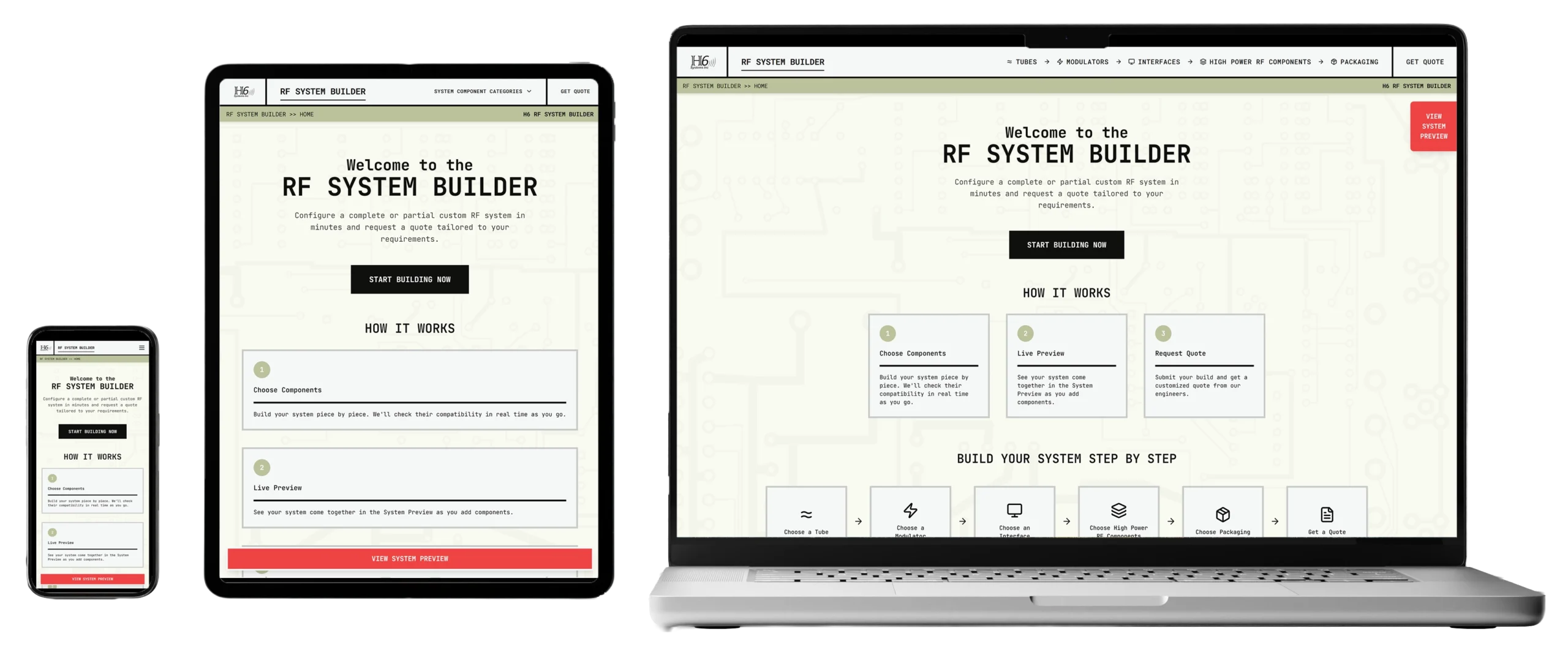
Use our RF System Builder Tool to build a complete or partial custom klystron-based transmitter system in minutes, completely free! Then get a fast, tailored quote from our engineers.